

For years, we used the same tools everyone else did. Meta Business Manager, third-party scheduling platforms, new dashboards, old dashboards, “all-in-one” solutions. They all promised efficiency. None of them truly worked at agency scale.
The real problem wasn’t missing features. It was speed.
When you manage multiple brands, hundreds of posts, and repeating publishing decisions every month, most existing panels become slow, rigid, and unnecessarily manual. Planning one post is easy. Planning hundreds of posts across multiple clients is where things break.
Meta Business Manager, in particular, is a bottleneck:
- Slow interfaces
- Each post planned one by one
- No real rule-based publishing
- No meaningful way to automate repeating decisions
A simple need like: “Every Sunday, Monday, and Tuesday we publish Happy Hour content.”
…still requires manual effort, every single time.
That’s not a social media problem. That’s an operational one.
Repeating decisions shouldn’t require repeating work.
As an agency, we noticed something obvious but rarely addressed:
Most social media decisions are predictable.
- Certain content types repeat on certain days
- Publishing rhythms don’t change weekly
- Asset libraries already exist
- Performance data already tells us what works
Yet almost every tool treats each post as a brand-new action. We didn’t want to plan posts. We wanted to define rules once and let the system handle the rest.
Cost wasn’t just about pricing.
It was about scale. Most platforms charge per:
- User
- Brand
- Channel
As agencies grow, costs grow automatically even when workflows stay the same.
We wanted a system where:
- Every team member could work freely
- No per-user limitations existed
- Growth didn’t mean exponential software costs
Design and publishing were disconnected.
Another major friction point was design workflow. Our design team already works in Google Drive. Assets are categorized, reviewed, and finalized there.
Yet publishing meant:
- Opening another platform
- Searching for files
- Uploading again
- Repeating work already done
It was inefficient by design. So we asked a simple question:
“Why isn’t Drive the source of truth?” So we built a system around how agencies actually work.
Instead of adapting our workflow to existing tools, we built a system that adapts to us. At its core:
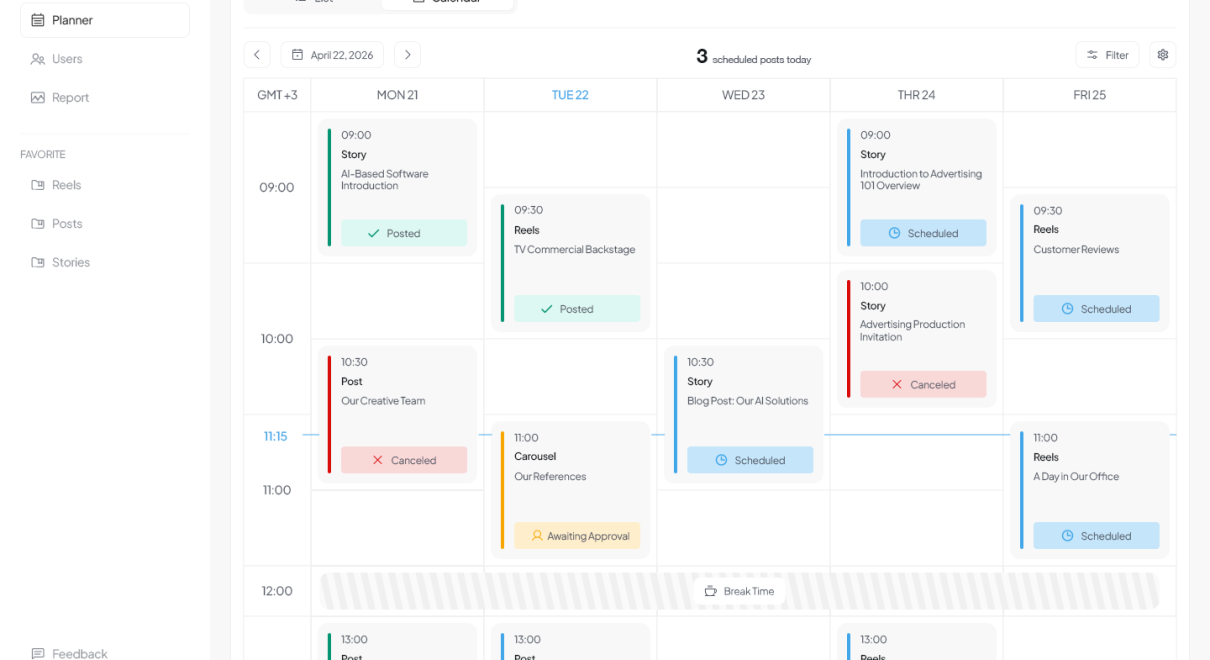
- Publishing is calendar-based, not post-based
- Decisions are rule-driven, not manual
- Assets are pulled directly from Drive folders
- Used content is automatically archived and never reused
- Performance feeds back into future publishing logic
- Errors never stay silent we get notified
No extra panels. No unnecessary UI layers. No repeated uploads. Just a system that understands agency rhythm.
This isn’t a product launch. And it’s not a tool for everyone.
It’s an internal system built to remove friction, save time, and give us control at scale. We didn’t build it to compete with existing platforms. We built it because none of them were built for how agencies actually operate.
Sometimes the fastest way forward is to stop searching for the right tool and start coding your own way of working.
What This System Is and What It Is Not
What this system is
It is an agency-scale publishing engine.
Built to handle multiple brands, large content volumes, and repeating decisions without slowing the team down.
It is rule-driven, not post-driven.
Publishing is based on predefined rhythms and calendars, not one-off manual actions.
It is deeply operational.
Designed around real agency workflows: design teams, content pools, approvals, exceptions, and performance feedback.
It is Drive-native.
Google Drive is the source of truth. Assets live where teams already work, without re-uploads or duplication.
It is cost-stable.
No per-user or per-brand scaling penalties. Growth doesn’t automatically increase software costs.
It is silent when things work, loud when they don’t.
Errors, missed posts, or inconsistencies trigger alerts instead of being discovered late.
It is performance-aware.
Publishing decisions evolve based on what actually performs, not just what was planned.
What this system is not
It is not a generic social media tool.
It wasn’t designed for creators, freelancers, or small teams managing one account.
It is not a replacement for creative thinking.
It automates execution, not strategy or ideas.
It is not a drag-and-drop calendar UI.
Speed and clarity matter more than visual polish.
It is not built for every platform.
The focus is intentional: Facebook and Instagram first. Expansion is deliberate, not rushed.
It is not trying to compete feature-by-feature with large platforms.
Its value comes from removing friction, not adding checkboxes.
It is not something we sell (at least not yet).
This system exists because we needed it to work for us.
In short
This system exists to do one thing well turn recurring agency decisions into a reliable, low-friction publishing process.
Nothing more. Nothing less.